

Advanced warning system, subway barriers in place to mitigate Ditwah damage
Officials said more locations will be added based on field assessments, and the integrated systems would help shorten response time and minimise damage during heavy rainfall events.
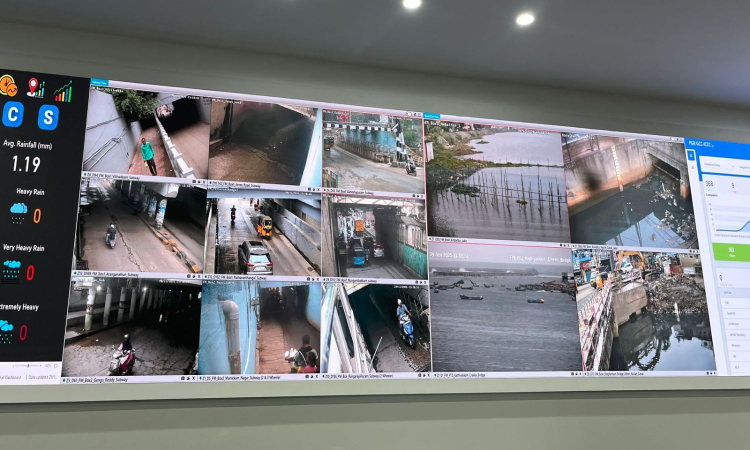
Areas being monitored by cctv cameras
CHENNAI: The Greater Chennai Corporation (GCC) is ramping up its monsoon and cyclone preparedness by integrating technology-driven systems through its Integrated Command and Control Centre (ICCC). Using its Early Warning System (EWS) application, the civic body says it can now issue quicker and more accurate alerts on flooding, waterlogging and infrastructure risks during the northeast monsoon.
According to corporation officials, the EWS platform is the first of its kind among urban local bodies in Tamil Nadu. The system is designed to help field teams respond faster and guide residents towards the nearest support facilities during emergencies.
“In this application, we have the complete database of inundation-prone areas, details of motor pumps, zonal offices, night shelters and relief centres. For instance, the app can guide users to the exact location of a zonal office and provide the contact numbers of zonal officers, executive engineers and nodal officers,” a GCC official said.
The EWS also includes information such as the number of government schools, colleges, hospitals, Urban Primary Health Centres and Urban Community Health Centres across the city. It records the quantity of food supplied at relief centres and integrates multiple dashboards, including daily rainfall forecasts, ocean forecast data, flood meters, smart parking and departmental modules covering solid waste management, mechanical engineering and revenue sections.
A recurring challenge during the monsoon is water stagnation in the city’s 22 subways. Of these, GCC has installed automatic boom barriers in 17 low-lying subways such as Stanley Nagar, Gengu Reddy Road, Jones Road and Aranganathan Subway, as well as the limited-use subway beneath the Murasoli Maran Road overbridge.
As part of a pilot project, each barrier is connected to a control unit that monitors predefined water levels. When water rises beyond the threshold, the barriers close automatically or can be closed manually from the ICCC at Ripon Buildings. Sirens and alarms are triggered moments before the closure to warn motorists.
Welcoming the move, RaghuKumar Choodamani, convener of the Perambur Neighbourhood Development Forum, said, “Installing boom barriers is a good initiative, especially to prevent vehicles from entering inundation-prone subways. However, awareness about the system must be increased so that the public understands why the barriers close."
GCC has also embedded 159 electric motor pumps with control units linked to the ICCC, enabling real-time monitoring of pump location, operating status and running hours. Flood-monitoring CCTVs, known as flood meters, have been installed at 40 vulnerable points, including Kargil Nagar, Vetri Vinayagar Nagar and Edayanchavadi in Tiruvottiyur; CMDA Truck Terminal and Elizabeth Nagar in Madhavaram; and AE Koil Street, MKB Nagar and Muthamil Nagar in Tondiarpet.
Officials said more locations will be added based on field assessments, and the integrated systems would help shorten response time and minimise damage during heavy rainfall events.
Meanwhile, Minister for Revenue and Disaster Management KKSSR Ramachandran told reporters that no loss of life had been reported so far. However, 16 cattle had died, and 24 huts were fully damaged.